Showing posts with label alarm. Show all posts

Saturday, January 11, 2014

Cheap Bicycle Alarm Schematics

The author wanted a very cheap and simple alarm for some of his possessions, such as his electrically assisted bicycle. This alarm is based on a cheap window alarm, which has a time-switch added to it with a 1-minute time-out. The output  pulse of the 555 replaces the reed switch in the window alarm. The 555 is triggered by a sensor mounted near the front  wheel, in combination with a magnet that is mounted on the spokes. This sensor and the magnet were taken from a cheap bicycle computer.

Circuit diagram :
Cheap Bicycle Alarm-Circuit Diagram
Cheap Bicycle Alarm Circuit Diagram

The front wheel of the bicycle is kept unlocked, so that the reed  switch closes momentarily when the wheel turns. This  triggers the 555, which in turn activates the window alarm. The circuit around the 555 takes very little current and can  be powered by the batteries in the window alarm.  There  is just enough room  left inside the enclosure of the window  alarm to mount the time-switch inside it.

The result is a very cheap, compact device, with only a single cable going to the reed switch on the front wheel. And the noise this thing produces is just unbelievable! After about one minute the noise stops and the alarm goes back into standby mode. The bicycle alarm should be mounted in an inconspicuous place, such as underneath the saddle, inside a (large) front light, in the battery compartment, etc.

Hopefully the alarm scares any potential thief away, or at least it makes other members of the public aware that something isnt quite right.


Caution. The installation and use of this circuit may be subject to legal restrictions in your country, state or area.

Continue Reading[...]

Tuesday, December 17, 2013

ANTI BAG SNATCHING ALARM

     Here is a simple alarm circuit to thwart snatching of your valuables while travelling. The circuit kept in your bag or suitcase sounds a loud alarm, simulating a p attempts to snatch your bag or suitcase. This will draw the attention of other  passengers and the burglar can be caught red handed.
www.blogger.com


     In the standby mode, the circuit is locked by a plug and socket arrangement (a mono plug with shorted leads plugged into the mono-jack socket of the unit). When the burglar tries to snatch the bag, the plug detaches from the unit’s socket to activate the alarm.

     The circuit is designed around op-amp IC CA3140 (IC1), which is configured as a comparator. The non-inverting input (pin 3) of IC1 is kept at half the supply voltage (around 4.5V) by the potential divider comprising resistors R2 and R3 of 100 kilo-ohms each. The inverting input (pin 2) of IC1 is kept low through the shorted plug at the socket. As a result,olice horn, if someone the voltage at the non-inverting input is higher than at the inverting input and the output of IC1 is high.

     The output from pin 6 of IC1 is fed to trigger pin 2 of IC NE555 (IC2) via coupling capacitor C1 (0.0047 μF). IC2 is configured as a monostable. Its trigger pin 2 is held high by resistor R4 (10 kilo-ohms). Normally, the output of IC2 remains low and the alarm is off. Resistor R6, along with capacitor C3 connected to reset pin 4 of IC2, prevents any false triggering. Resistor R5 (10 mega-ohms), preset VR (10 megaohms) and capacitor C2 (4.7 μF, 16V) are timing components. With these values, the output at pin 3 of IC2 is about one minute, which can be increased by increasing either the value of capacitor C2 or preset VR.

     When there is an attempt at snatching, the plug connected to the circuit detaches. At that moment, the voltage at the inverting input of IC1 exceeds the voltage at the non-inverting input and subsequently its output goes low. This sends a low pulse to trigger pin 2 of IC2 to make its output pin 3 high. Consequently, the alarm circuit built around IC UM3561 (IC3) gets the supply voltage at its pin 5.

     IC UM3561 is a complex ROM with an inbuilt oscillator. Resistor R8 forms the oscillator component. Its output is fed to the base of single-stage transistor amplifier BD139 (T1) through resistor R9 (1 kilo-ohm)

      The alarm tone generated from IC3 is amplified by transistor T1. A loudspeaker is connected to the collector of T1 to produce the alarm. The alarm can be put off if the plug is inserted into the socket again. Transistor T1 requires a heat-sink.

     Resistor R7 (330 ohms) limits the current to IC3 and zener diode ZD1 limits the supply voltage to IC3 to a safe level of 3.3 volts. Resistor R9 limits the current to the base of T1.

     The circuit can be easily constructed on a vero board or general-purpose PCB. Use a small case for housing the circuit and 9V battery. The speaker should be small so as to make the gadget handy. Connect a thin plastic wire to the plug and secure it in your hand or tie up somewhere else so that when the bag is pulled, the plug detaches from the socket easily.
Continue Reading[...]

Friday, April 12, 2013

Heat Detector Alarm using UM3561

A very simple heat detector alarm electronic project can be designed using the UM3561 sound generator circuit and some other common electronic parts . This heat detector electronic circuit project uses a complementary pair comprising npn and pnp transistor to detect heat Collector of T1 transistor is connected to the base of the T2 transistor , while the collector of T2 transistor is connected to RL1 relay T3 and T4 transistors connected in darlington configuration are used to amplify the audio signal from the UM3561 ic.
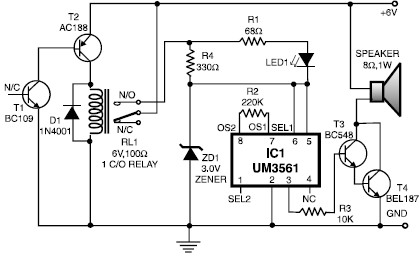
Circuit Project: Heat detector alarm circuit using UM3561
When the temperature close to the T1 transistor is hot , the resistance to the emitter –collector goes low and it starts conducting . In same time T2 transistor conducts , because its base is connected to the collector of T1 transistor and the RL1 relay energized and switches on the siren which produce a fire engine alarm sound. This electronic circuit project must be powered from a 6 volts DC power supply , but the UM3561 IC is powered using a 3 volt zener diode , because the alarm sound require a 3 volts dc power supply. The relay used in this project must be a 6 volt / 100 ohms relay and the speaker must have a 8 ohms load and 1 watt power.
 
 
Streampowers
Continue Reading[...]

Tuesday, April 9, 2013

Build a Radio Wave Alarm

This simple circuit is sure to have the police beating a path to your door- however, it has the added advantage of alerting you to their presence even before their footsteps fall on the doormat.

Simple Radio Wave Alarm Circuit Diagram :
Build a Radio Wave Alarm

Notes :
  • The circuit transmits on Medium Wave (this is the small problem with the police). IC1a, together with a sensor (try a 20cm x 20cm sheet of tin foil) oscillates at just over 1MHz. This is modulated by an audio frequency (a continuous beep) produced by IC1b. When a hand or a foot approaches the sensor, the frequency of the transmitter (IC1a) drops appreciably.
  • Suppose now that the circuit transmits at 1MHz. Suppose also that your radio is tuned to a frequency just below this. The 1MHz transmission will therefore not be heard by the radio. But bring a hand or a foot near to the sensor, and the transmitters frequency will drop, and a beep will be heard from the radio.
  • Attach the antenna to a multiplug adapter that is plugged into the mains, and you will find that the Medium Wave transmission radiates from every wire in your house. Now place a suitably tuned Medium Wave radio near some wires or a plug point in your house, and an early-warning system is set up.
  • Instead of using the sheet of tin foil as the sensor, you could use a doorknob, or burglar bars. Or you could use a pushbutton and series resistor (wired in series with the 33K resistor - the pushbutton would short it out) to decrease the frequency of IC1a, so activating the system by means of a pushbutton switch. In this case, the radio would be tuned to a frequency just below that of the transmitter.
Continue Reading[...]

Thursday, April 4, 2013

Broken Charger Connection Alarm

Detects if a device is not properly connected to its supply Suitable for battery chargers, portable appliance supplies etc.
The above circuit can be useful to detect if the load of any battery charger or plug-in adapter supply is not properly connected. The load can be a set of batteries to be charged or any other type of battery or low dc voltage operated device. The circuit can safely operate over a 3 to 15V range and 1A max. Current, provided the supply voltage is about one volt higher than the voltage required by the load.
The circuit is inserted between the supply and the load; therefore, until a trickle-charging current of at least 100µA is flowing towards the load, D1 and D2 will conduct. The forward voltage drop (about 1V) available across the Diodes drives Q2 into conduction and, consequently, Q1 will be cut-off. If no appreciable load is connected across the circuits output, Q2 will become cut-off, Q1 will conduct and the Piezo-sounder will beep.
Circuit diagram:
Broken Charger Connection Alarm Broken Charger Connection Alarm Circuit Diagram
Parts Description
R1 10K
R2 1K
R3 1K
Q1 BC557
Q2 BC557
D1 1N4007
D2 1N4007
D3 Red LED
BZ1 Piezo Sounder
Notes:
  • An optional LED and its series limiting resistor can be wired in parallel to BZ1, as shown in dotted lines in the circuit diagram.
  • In this case you may omit the Piezo-sounder in order to obtain a visual alert only.
Continue Reading[...]