Showing posts with label power. Show all posts

Friday, January 10, 2014

30V Variable Power Supply Using LM317

This 30v variable power supply circuit is based on LM317  voltage regulator circuit . This LM317 30v variable power supply circuit can deliver high current (around 5 amps) and variable output voltage between 1.2 volts, up to 30 volts. The led D3 mounted on pin 6 at lm301 lights in constant current mode .

Circuit diagram 

Current limit can be adjusted using R2 potentiometer and the output voltage can be adjusted from 1.2 volts to 30 volts using R8 potentiometer . Input voltage for this variable power supply must be around 35 volts .For this power supply circuit you need to use LM317K circuit (in to3 package ) which must be mounted on a heatsink .
Continue Reading[...]

Wednesday, December 25, 2013

Simple Microprocessor power supply watchdog circuit Diagram

The Simple Microprocessor power supply watchdog circuit Diagram monitors the input to the microprocessor 5 V regulated supply for voltage drops and initiates a reset sequence before supply regulation is lost. In operation, the resistor capacitor combination Rs and Cj form a short time constant smoothing network for the output of the fullwave bridge rectifier. 

An approximately triangular, voltage waveform appears across C and Rs and it is the minimum excursion of this that initiates the reset. Diode Dg prevents charge sharing between capacitors Cj and Ck. Resistors Rn and Rm form a feedback network around the voltage reference section of the LM10C, setting a threshold voltage of 3.4 volts. 

 Microprocessor power supply watchdog circuit Diagram

Simple Microprocessor power supply watchdog circuit Diagram


The threshold voltage is set at 90% of the minimum voltage of the triangular waveform. When the triangular wave trough, at the comparators non-inverting input, dips below the threshold, the comparator output is driven low. This presents a reset to the microprocessor. Capacitor Ch is charged slowly through resistor Rk and discharged rapidly through diode De.
Continue Reading[...]

Wednesday, August 7, 2013

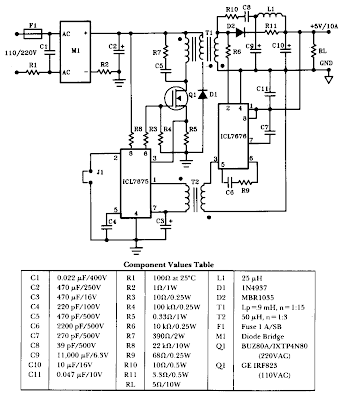
50W Offline Switching Power supply Circuit Diagram

The schematic shows a 50W power supply with a 5-V 10-A output. It is a fly back converter operating in the continuous mode. The circuit features a primary side and secondary side controller will full-protection from fault conditions such as over current. After the fault condition has been removed, the power supply will enter the soft-start cycle before recommencing normal operation.

50W Offline Switching Power supply Circuit Diagram

50W Offline Switching Power supply Circuit Diagram

Continue Reading[...]

Wednesday, May 29, 2013

How to Build a Simplest Modified Sine Wave Power Inverter Circuit


If you are looking for a simple modified sine wave power inverter circuit design to build, then perhaps you have hit the bull’s eye here. The present article very explicitly deals with a circuit idea of the same that’s astonishingly simple and low cost with an output that’s to a very extent is comparable with its sine wave counterparts.

Here we discuss a circuit design of a modified sine wave power inverter unit that’s probably the simplest and the cheapest to build. Whole circuit description and circuit schematic is included here in, read on.....


Circuit Design Discussion
In one of my recent articles I discussed a circuit design of a modified sine wave power inverter and we came to know how it’s different and more efficient than a few other designs available in some other websites. In this article we go through yet another design of a modified sine wave inverter which may not be as efficient as the previous one but is definitely better than a square wave design and is also perhaps the simplest one to build.
Folks who are new to electronics may get a bit confused regarding the difference between a square wave and a modified square wave inverter. It may be understood through the following brief explanation:
As we all know an inverter will always generate an alternating current (AC) similar to our domestic AC line voltage so that it can replace it during power failures. An AC in simple words is basically a rise and fall of voltage of a particular magnitude.
This rise and fall of voltage happens at a particular rate i.e. at a particular number of times per second, known as its frequency. So for example a 50 Hz AC means 50 cycles or 50 ups and downs of a particular voltage in one second.
In a sine wave AC as found in our normal domestic mains outlet the above rise and fall of voltage is in the form of a sinusoidal curve, i.e. its pattern gradually varies with time and thus is not sudden or abrupt. Such smooth transitions in the AC waveform becomes very suitable and a recommended type of supply for the many common electronic gadgets like TVs , music systems , Refrigerators, motors etc.
However, in a square wave pattern the voltage ups and downs are instant and sudden. Such immediate rise and fall of potential creates sharp spikes at the edges of each wave and thus becomes very undesirable and unsuitable for sophisticated electronic equipments. Therefore it is always dangerous to operate them through a Square weave inverter supply.
In a modified square wave design, the waveform shape basically remains the same but the size of each section of the wave-form is appropriately dimensioned so that its average value matches closely to an AC waveform’s average value.
For the present design we yet again take the help of the evergreen versatile IC 4017.
We know that when a clock input is applied to its pin #14, the IC produces a shifting cycle logic high pulses through its 10 output pins.
Looking at the circuit diagram we find that the pin outs of the IC are terminated to supply the base of the output transistors such that they conduct after every alternate output pulse from the IC.
This happens simply because the bases of the transistors are connected alternately to the IC pin outs and the intermediate pin-out connections are just eliminated or kept open.
The transformer windings which are connected to the transistor’s collector respond to the alternate transistor switching and produce a stepped up AC at its output having a waveform exactly as shown in the diagram.
The output of this Modified sine wave power inverter is although not quite comparable to the output of a pure sine wave inverter but definitely will be far better than that of an ordinary square wave inverter. Moreover the idea is very easy and cheap to build.


QUIZ = Can anybody tell the reason behind powering IC2 via T0 and the associated circuit instead of providing a direct supply to its pin 16?


Parts List

R1=20K
R2,R3=1K
R4,R5=220 Ohms, 1 watt
C1=0.095Uf
C2,C3,C4=10UF/25V
T0 = BC557B
T1,T2=TIP122
T3,T4=BDY29
IC1= SN74LVC1G132 or a single gate from IC4093
IC2=4017
IC3=7805
TRANSFORMER=12-0-12V/10AMP/230V

Continue Reading[...]

Saturday, April 13, 2013

Non Contact Power Monitor circuit

Here is a simple non-contact AC power screen for house appliances and laboratory equipment that should stay constantly switched-on. A fuse failure or power breakdown within the tools going overlooked may just result in irreparable loss. The monitor sounds an alarm on detecting energy failure to the equipment. The circuit is built round CMOS IC CD4011 utilising just a few components. NAND gates N1 and N2 of the IC are wired as an oscillator that drives a piezobuzzer instantly. Resistors R2 and R3 and capacitor C2 are the oscillator elements. The amplifier comprising transistors T1 and T2 disables the oscillator when primarys power is available. In the standby mode, the base of T1 picks up 50Hz primarys hum all the manner through the positive half cycles of AC and T1 conducts.

Circuit diagram:
   
Non-Contact Power Monitor circuit diagram
  
This offers base current to T2 and it additionally habitss, pulling the collector to ground potential. As the collectors of T1 and T2 are connected to pin 2 of NAND gate N1 of the oscillator, the oscillator will get disabled when the transistors behavior. Capacitor C1 forestalls upward throughst of the collector voltage of T2 once more right through the terrible half cycles. When the facility fails, the electrical field across the equipment’s wiring ceases and T1 and T2 turn off. Capacitor C1 begins charging via R1 and preset VR and when it will get sufficiently charged, the oscillator is enabled and the piezobuzzer produces a shrill tone. Resistor R1 give safety tos T2 from short circuit if VR is altered to zero resistance.

The circuit can be easily assembled on a perforated/breadboard. Use a small plastic case to enclose the circuit and a telescopic antenna as aerial. A 9V battery can be used to power the circuit. Since the circuit attracts only some microamperes current within the standby mode, the battery will closing a couple of months. After assembling the circuit, take the aerial close to the primarys cable and modify VR except the alarm stops to indicate the standby mode. The circuit will additionally be placed on the gear to be displayed as regards to the principles cable.


http://www.ecircuitslab.com/2011/06/non-contact-power-monitor-circuit.html
Continue Reading[...]

Thursday, April 11, 2013

Dual Voltage Power Supply 12 Volt

This is the straightforward circuit diagram of Dual Voltage\r\n Power Supply. It is used for Misc… software. This circuit is known as \r\nregulated energy provide. For this reason the principle portion of this \r\ncircuit is Regulator IC. It also needs few parts to constructed. The regulator 7812 is the certain voltage regulator and  7912 is the bad voltage regulator. 

You may additionally use 7809 for 9 volt sure power provide and 7909 for poor voltage power provide. 

It regulates voltage from 24Volt to 12 Volt (DC). The transformer\r\n enter is 110Volt to 220Volt (AC) and the output need to be between 12Volt \r\nto 24Volt (AC) and present need to be 500mA. In this circuit some \r\ncapacitors are used as a filter for disposing of repole.

Continue Reading[...]

Wednesday, April 10, 2013

LM4651 and LM4652 170W power amplifier

170 Watt power amplifier is a power amplifier that is built by IC LM4651 and LM4652.

Part of this power amplifier driver using the LM4651 IC designed specifically for the purpose of the class AB amplifier driver with short circuit protection feature, containing under voltage, thermal shutdown protection and standby functions. Section 170 Watt power amplifier using LM4651 IC with a MOSFET power amplifier is equipped with temperature sensors that will be used by IC LM4651 as controlnya thermal signal. IC IC LM4651 and LM4652 are designed specifically to each other in pairs to create a class AB power amplifier with protection features are detailed. Detailed series of 170 Watt power amplifier can be seen in thethe following figure .

LM4651 and LM4652 170W power amplifier

Power amplifier circuit requires supply voltages +22 V DC symmetrical 0-22V. Power Amplifier with IC LM4651 and LM4652 are often used in portable HiFi systems such as powered speakers, power subwoofer and car audio power Booter. D1, D2, D3 and D4 in series 170 watt power amplifier with LM4651 and LM4652 is a 22V zener diode.
Continue Reading[...]

Sunday, April 7, 2013

Low Power Voltage Doubler Circuit Diagram


All
miniature electronic devices operate off batteries. Some of them need
higher than the standard battery voltages to operate efficiently. If
the battery of that specific voltage is unavailable, we are forced to
connect additional cells in series to step up the DC voltage. Thus, the
true meaning of miniaturisation is lost. A simple way to overcome this
problem is to employ a voltage doubler, if the device under
consideration can operate at a small current.

Here we present a
low-power voltage doubler circuit that can be readily used with devices
that demand higher voltage than that of a standard battery but low
operating current to work with. The circuit is quite simple as it uses
only a few components. Yet, the output efficiency is 75 to 85 percent
along its operating voltage range. The available battery voltage is
almost doubled at the output of the circuit.

Here IC1 is wired as
an astable multivibrator to generate rectangular pulses at around 10
kHz. This frequency and duty cycle of the pulses can be varied using
preset VR1. The pulses are applied to switching transistors T1 and T2
for driving the output section, which is configured as a
voltage-doubling circuit. The doubled voltage is available across
capacitor C5. During each cycle of the pulse occurance, the high level
drives T1 into its saturation, keeping transistor T2 cut off.

Circuit diagram:
low-power voltage doubler circuit schematic
Low-Power Voltage Doubler Circuit Diagram

So
transistor T1 charges capacitor C4 via the path formed by diodes D2
and D1 to a voltage level slightly lesser than the supply. But during
the low period of the pulse, transistor T1 is cut off while transistor
T2 is driven into saturation. Now, transistor T2 raises the charge on
the negative pole of capacitor C4 by another step equal to the supply
voltage. Therefore an equal amount of charging is built up on capacitor
C5 via diode D3.

This doubling action increases the total
voltage across capacitor C5 to almost double the input voltage. If the
output of the pulse generator is maintained with a high enough
amplitude and frequency, the output voltage and current remain constant
and cater to the needs of the load. Even with the half-wave function,
this circuit is almost free of ripple voltage. If the connected load
doesn’t require a high current, the efficiency can be expected in the
upper 90 percentranges.

Since the input voltage is doubled, the
current drain from the input power supply is also doubled at the input
but halved at the output. One point of caution is that if the
multivibrator’s frequency is fairly high, the output may suffer with the
interference imposed over the DC voltage. In this case, the frequency
must be set favorably by trials and actual load connection procedure.
This tiny circuit can be assembled on the general-purpose PCB. If all of
the components are surface-mount type, the whole module can be
genuinely miniaturized.

EFY Lab note.
During testing with input of 8V and 1.25mA load current the output voltage was found to be around 13V.
Source: EFY Mag
Continue Reading[...]

Stereo Power Amplifier Circuit based on BA5417

BA5417 is a stereo amplifier IC with a lot of good features like thermal shut down, standby function, soft clipping, wide operating voltage range etc. The IC can deliver 5W per channel into 4 ohm loud speakers at 12V DC supply voltage. The BA5417 has excellent sound quality and low THD (total harmonic distortion) around 0.1% at F=1kHz; Pout=0.5W.

Stereo Power Amplifier  Circuit diagram :

stereo-amplifier-circuit BA5417-

Setup and working of this stereo power amplifier circuit is somewhat similar to the BA5406 based stereo amplifier circuit published previously. C10 and C11 are DC decoupling capacitors which block any DC level present in the input signals. C2 and C6 couples the amplifiers left and right power outputs to the corresponding loud speakers. C1 and C5 are bootstrap capacitors.

Bootstrapping is a method in which a portion of the amplifiers is taken and applied to the input. The prime objective of bootstrapping is to improve the input impedance. Networks R1,C3 and R2,C7 are meant for improving the high frequency stability of the circuit. C4 is the power supply filter capacitor. S1 is the standby switch. C8 is a filter capacitor. R3 and R4 sets the gain of the left and right channels of the amplifier in conjunction with the 39K internal feedback resistors.
Note :
  • Supply voltage range of BA5417 is from 6 to 15V DC.
  • The recommended supply voltage for this circuit is 12V DC.
  • The power supply must be well regulated and filtered.
  • BA5417 requires a heatsink.
  • The circuit can be assembled on a perf board without much degradation in performance.

Source : http://www.ecircuitslab.com/2012/07/stereo-power-amplifier-circuit-based-on.html
Continue Reading[...]