Showing posts with label circuit. Show all posts

Wednesday, December 25, 2013

Simple Microprocessor power supply watchdog circuit Diagram

The Simple Microprocessor power supply watchdog circuit Diagram monitors the input to the microprocessor 5 V regulated supply for voltage drops and initiates a reset sequence before supply regulation is lost. In operation, the resistor capacitor combination Rs and Cj form a short time constant smoothing network for the output of the fullwave bridge rectifier. 

An approximately triangular, voltage waveform appears across C and Rs and it is the minimum excursion of this that initiates the reset. Diode Dg prevents charge sharing between capacitors Cj and Ck. Resistors Rn and Rm form a feedback network around the voltage reference section of the LM10C, setting a threshold voltage of 3.4 volts. 

 Microprocessor power supply watchdog circuit Diagram

Simple Microprocessor power supply watchdog circuit Diagram


The threshold voltage is set at 90% of the minimum voltage of the triangular waveform. When the triangular wave trough, at the comparators non-inverting input, dips below the threshold, the comparator output is driven low. This presents a reset to the microprocessor. Capacitor Ch is charged slowly through resistor Rk and discharged rapidly through diode De.
Continue Reading[...]

Monday, December 23, 2013

Build a Remotely Adjustable Solid State High voltage Supply Circuit Diagram

How to build a remotely adjustable solid state high-voltage supply Circuit Diagram. The output voltage changes approximately linearly up to 20 KV as the input voltage is varied from 0 to 5 V. The oscillator is tuned by a 5-0 potentiometer to peak the output voltage at the frequency of maximum transformer response between 45 and 55 kHz. 

The feedback voltage is applied through a 100-KO resistor, an op amp, and a comparator to a high-voltage amplifier. A diode and varistors on the primary side of the transformer protect the output transistor. The transformer is a flyback-type used in color-television sets. A feedback loop balances between the high-voltage output and the low-voltage input.


Remotely Adjustable Solid State High-voltage Supply Circuit Diagram


Remotely Adjustable Solid State High-voltage Supply Circuit Diagram
Continue Reading[...]

Saturday, December 21, 2013

Battery Powered High voltage Generator Circuit Diagram

This is the battery powered high-voltage generator circuit diagram. Output voltage great enough to jump a l-inch gap can be obtained from a 12-V power source. A 555 timer IC is connected as an stable multi vibrator that produces a narrow negative pulse at pin 3. The pulse turns Ql on for the duration of the time period. The collector of Ql is direct-coupled to tbe base of tbe power transistor Q2, turning it on during the same time period. 

The emitter of Q2 is direct -coupled through current limiting resistor R5 to the base of the power transistor. Q3 switches on, producing a minimum resistance between the collector and emitter. The high-current pulse going through tbe primary of high-voltage transformer Tl generates a very high pulse voltage at its secondary output terminal (labeled X). The pulse frequency is determined by tbe values of Rl, R2, and C2. The values given in the parts list were chosen to give the best possible performance when an auto-ignition coil is used for Tl. 

Battery Powered High-voltage Generator Circuit Diagram

Battery Powered High-voltage Generator Circuit Diagram
 
Continue Reading[...]

Thursday, December 19, 2013

Video Tracer Circuit Diagram

This circuit was designed as an aid to installers and maintainers of video systems. It is basically a video sync separator (IC1) followed by a LED and buzzer driver (IC2, Q1 & Q2). In use, the device is connected to a video cable and if there is video present, the LED will flash at about 10Hz. If there is no video, the LED flashes briefly every couple of seconds. A buzzer can also be switched in to provide an audible indication. The buzzer is particularly useful when tracing cabling faults or trying to find a correct cable amongst many, where it is difficult to keep an eye on the LED.

Another use for the buzzer option is to provide a video fault indication. For example, it could be inserted in bridging mode, with switch S1 in high impedance mode (position 2) across a video line and set to alarm when there is no video present. If someone pulls out a cable or the video source is powered off, the alarm would sound. IC1 is a standard LM1881 video sync separator circuit and 75Ω termination can be switched in or out with switch S1a. The other pole of the switch, S1b, turns on the power. The composite sync output at pin 1 is low with no video input and it pulses high when composite sync is detected.

Video Tracer Circuit diagram:

video-tracer-circuit-for-trouble-shooting1

These pulses charge a 100nF capacitor via diode D1. When there is no video at the input, oscillator IC2b is enabled and provides a short pulse every couple of seconds to flash the LED. The duty cycle is altered by including D2, so that the discharge time for the 10μF capacitor is much shorter than the charge time. The short LED pulse is used as a power-on indicator drawing minimal average current. When video is present at the input, IC2b is disabled and IC2d is enabled. The output of IC2d provides a 10Hz square wave signal to flash the LED. The buzzer is controlled by switch S2. In position 2 the buzzer will sound when there is video at the input and in position 1 the buzzer will sound when there is no video at the input.

Source : http://www.ecircuitslab.com/2011/07/video-tracer-circuit-diagram.html
Continue Reading[...]

Wednesday, October 2, 2013

2 Line Intercom Cum Telephone Line Changeover Circuit

The circuit presented here can be used for connecting two telephones in parallel and also as a 2-line intercom. Usually a single telephone is connected to a telephone line. If another telephone is required at some distance, a parallel line is taken for connecting the other telephone. In this simple parallel line operation, the main problem is loss of privacy besides interference from the other phone. This problem is obviated in the circuit presented here. Under normal condition, two telephones (telephone 1 and 2) can be used as intercom while telephone 3 is connected to the lines from exchange. In changeover mode, exchange line is disconnected from telephone 3 and gets connected to telephone 2. For operation in intercom mode, one has to just lift the handset of phone 1 and then press switch S1.

As a result, buzzer PZ2 sounds. Simultaneously, the side tone is heard in the speaker of handset of phone 1. The person at phone 2 could then lift the handset and start conversation. Similar procedure is to be followed for initiation of the conversation from phone 2 using switch S2. In this mode of operation, a 3-pole, 2-way slide-switch S3 is to be used as shown in the figure. In the changeover mode of operation, switch S3 is used to changeover the telephone line for use by telephone 2. The switch is normally in the intercom mode and telephone 3 is connected to the exchange line. Before changing over the exchange line to telephone 2, the person at telephone 1 may inform the person at telephone 2 (in the intercom mode) that he is going to changeover the line for use by him (the person at telephone 2).

2-Line Intercom-Cum-Telephone Line Changeover Circuit DiagramAs soon as changeover switch S3 is flipped to the other position, 12V supply is cut off and telephones 1 and 3 do not get any voltage or ring via the ring-tone-sensing unit. Once switch S3 is flipped over for use of exchange line by the person at telephone 2, and the same (switch S3) is not flipped back to normal position after a telephone call is over, the next telephone call via exchange lines will go to telephone 2 only and the ringtone-sensing circuit will still work. This enables the person at phone 3 to know that a call has gone through. If the handset of telephone 3 is lifted, it is found to be dead. To make telephone 3 again active, switch S3 should be changed over to its normal position.
Continue Reading[...]

Thursday, September 12, 2013

Simple FM Transmitter Circuit Diagram

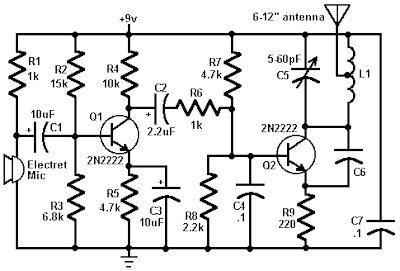
This circuit is a simple two transistor (2N2222) FM transmitter. No license is required for this transmitter according to FCC regulations regarding wireless microphones. If powered by a 9 volt battery and used with an antenna no longer than 12 inches, the transmitter will be within the FCC limits.

The microphone is amplified by Q1. Q2, C5, and L1 form an oscillator that operates in the 80 to 130 MHz range. The oscillator is voltage controlled, so it is modulated by the audio signal that is applied to the base of Q2. R6 limits the input to the RF section, and its value can be adjusted as necessary to limit the volume of the input. L1 and C6 can be made with wire and a pencil. The inductor (L1) is made by winding two pieces of 24 gauge insulated wire, laid side by side, around a pencil six times. Remove the coil you have formed and unscrew the two coils apart from each other. 

  FM Transmitter Circuit Diagram

  FM Transmitter Circuit Diagram


One of these coils (the better looking of the two) will be used in the tank circuit, and the other can be used in the next one you build. The antenna (24 gauge wire) should be soldered to the coil you made, about 2 turns up from the bottom, on the transistor side, and should be 8-12 inches long. To make C6, take a 4 inch piece of 24 gauge insulated wire, bend it over double and, beginning 1/2" from the open end, twist the wire as if you were forming a rope. When you have about 1" of twisted wire, stop and cut the looped end off, leaving about 1/2" of twisted wire (this forms the capacitor) and 1/2" of untwisted wire for leads.
Continue Reading[...]

Tuesday, September 10, 2013

Touch Controlled Mute Switch Circuit Diagram

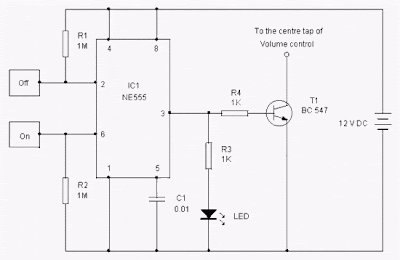
Here is another simple circuit to mute the volume of Audio devices through simple touch. It exploits the action of the flip-flops in the timer IC 555 to reduce the volume of the Audio amplifier. IC NE555 is designed in the toggle mode. Its lower and upper comparator inputs are connected to the touch plates which can be membrane switches or two pieces of conducting plates. The inputs of comparators are stabilized through R1 and R2 to avoid floating.

Touch controlled Mute switch circuit diagram

 Touch Controlled Mute Switch Circuit Diagram

 
When the touch plate connected to pin 2 is touched momentarily, output of IC1 goes high and T1 conducts. The centre tap of the volume control is connected to the collector of T1. So when T1 conducts current going to the amplifier drains through T1. This reduces the volume.IC1 remains latched in this position with LED on. When the touch plate connected to pin 6 is touched momentarily, output of IC1 goes low and T1 turns off. This restores the volume.

Continue Reading[...]

Thursday, August 15, 2013

Active band reject filter Circuit

A filter with a band-reject characteristic is frequently referred to as a notch filter. A typical circuit using a µ 741 is the unity-gain configuration for this type of active filter shown. The filter response curve shown is a second-order band-reject filter with a notch frequency of 3 kHz. The resulting Q of this filter is about 23, with a notch depth of - 31 dB.Although three passive networks are used in this application, the operational amplifier has become a sharply tuned low-frequency filter without the use of inductors or large-value capacitors.

 Active band-reject filter Circuit Diagram

 Active band-reject filter Circuit Diagran

Continue Reading[...]

Tuesday, August 13, 2013

TV Protect Circuit Dead or Damaged

Television set equipped with a circuit protector, then there are several possibilities that could occur if there is a problem on one of the circuits. Protect circuit horizontal part - When turned on the horizontal plane will live for a while, but then died again. At the time of death when measured on the horizontal driver indicates that no drive signal. If the power jack unplugged then try to turn on again then repeated a similar incident will happen again. But if if the base of the transistor or transistor try to open removable drive signal was viable.

Protect circuit of microcontroll - If checked the voltage at pin microcontrol power on-off control, power control is turned on when the plane going "on" for a while then back "off". If you unplugged the power jack will power "on" again, but briefly and then keep coming back "off". On certain models sometimes die when the aircraft was marked with the blazing LED indicators blink. Protect circuit tube - aircraft can be turned on but a dark raster. 
IC protek protek rusak
Protect IC

Tested voltage raster screen can be raised to normal flame or flame a horizontal line. Protect circuit the power supply - if enabled aircraft B + voltage of power supply there for a while but then lost or drops. Or the power supply voltage drops and there is but little rocking voltage, which is caused due to power supply to the death over and over again and again. There are models of televisions that do not use the protector system at all, there is only one system that uses a surge protector, but there are also some systems which use a surge protector as well. System protectors are made available for specific purposes. Keep track of the damage that led to protect circuit is sometimes difficult, because it always turns itself off the plane before we can make measurements. By getting to know a wide range of system protectors and understand how it works it will help overcome these difficulties.

Various kinds of protectors television system:
  • Protectors x-ray
  • Vertical Protectors
  • Protectors B + over current (OCP)
  • Protectors B + over voltage (OVP)
  • ABL Protectors
  • Supply voltage surge protector (if short or broken)
  • Protectors white balance
  • Protectors circuit power supply (SMPS)

Continue Reading[...]

Sunday, August 11, 2013

Simple Output limiter Circuit Diagram

Simple Output-limiter Circuit Diagram HA-5190 is rated for ±5 V output swing, and saturates at ±7 V. As with most op amps, recovery from output saturation is slow compared to the amplifier`s normal response time. Some form of limiting, either of the input signal or in the feedback path, is desirable if saturation might occur. The circuit illustrates a feedback limiter, where gain is reduced ifthe output exceeds ± ( Vz + 21j-). A 5-V zener with a sharp knee characteristic is recommended. 

Simple Output-limiter Circuit Diagram

Simple Output-limiter Circuit Diagram

Continue Reading[...]

Wednesday, August 7, 2013

50W Offline Switching Power supply Circuit Diagram

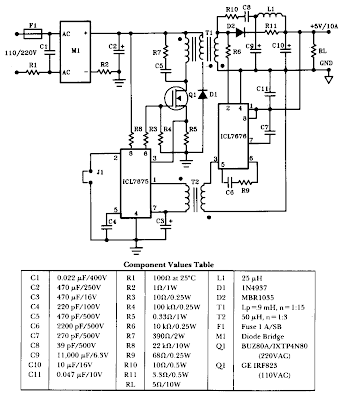
The schematic shows a 50W power supply with a 5-V 10-A output. It is a fly back converter operating in the continuous mode. The circuit features a primary side and secondary side controller will full-protection from fault conditions such as over current. After the fault condition has been removed, the power supply will enter the soft-start cycle before recommencing normal operation.

50W Offline Switching Power supply Circuit Diagram

50W Offline Switching Power supply Circuit Diagram

Continue Reading[...]

Thursday, August 1, 2013

Analog Signal Transmission Circuit Through DC Supply Line

If the sensor system need an active supply, we can use only a single pair of cable to carry both the power supply and the output signal. Not only simplify the wiring, converting analog voltage level to frequency modulated pulse improve the noise immunity as well. This is the figure of the circuit;


The diode is employed to prevent the capacitor voltage to be discharged when the transistor is grounding the supply voltage source to send a zero pulse. If the sensor or input system need a supply, we can tap the power from the 1uF capacitor, as long as it need only small current. [Circuit diagrams  source: Microchip Application Note]
Continue Reading[...]

Tuesday, July 30, 2013

Tunable Bandpass Filter Circuit Diagram

One of the difficulties in the design of higher-order tunable bandpass filters is achieving correct tracking of the variable resistors in the RC networks. The use of switched capacitor networks can obviate that difficulty, as is shown in this filter. The filter can be divided roughly into two stages: an oscillator that controls the electronic switches arid the four phase-shift networks that provide the filtering proper. 

Tunable Bandpass Filter Circuit Diagram

Tunable Bandpass Filter Circuit Diagram


The oscillator, based on a 555, generates a pulsating signal whose frequency is adjustable over a wide range: the duty factor varies from 1:10 to 100:1. Electronic switches ESI through ES4 form the variable resistors whose value is dependent on the frequency of the digital signal. The operation of these switches is fairly simple. When they are closed, their resistance is about 60 ; when they are open, it is virtually infinitely high. a switch is closed for, say, 25% of the time, its average resistance is therefore 240 . `Varying the open:closed ratio of each switch varies the equivalent average resistance. 

The switching rate of the switches must be much greater than the highest audio frequency to prevent audible interference between the audio and the clock signals. The input signal causes a given direct voltage across CI, so the op amp can be operated in a quasisym-metric manner, in spite of the single supply voltage. The direct voltage is removed from the output signal by capacitor C10. The fourth-order filter in the diagram can be used over the entire audio range and it has an amplification of about 40, although this depends to some extent on the clock frequency. The bandwidth depends mainly on the set frequency. The circuit draws a current of not more than 15 mA.
Continue Reading[...]

Wednesday, June 12, 2013

10Watt Audio Amplifier with Bass boost circuit


Circuit diagram

parts list 

P1_________________22K   Log.Potentiometer (Dual-gang for stereo)
P2________________100K   Log.Potentiometer (Dual-gang for stereo)
R1________________820R   1/4W Resistor
R2,R4,R8____________4K7  1/4W Resistors
R3________________500R   1/2W Trimmer Cermet
R5_________________82K   1/4W Resistor
R6,R7______________47K   1/4W Resistors
R9_________________10R   1/2W Resistor
R10__________________R22   4W Resistor (wirewound)

C1,C8_____________470nF   63V Polyester Capacitor
C2,C5_____________100µF   25V Electrolytic Capacitors
C3,C4_____________470µF   25V Electrolytic Capacitors
C6_________________47pF   63V Ceramic or Polystyrene Capacitor
C7_________________10nF   63V Polyester Capacitor
C9________________100nF   63V Polyester Capacitor

D1______________1N4148    75V 150mA Diode

IC1_____________NE5532    Low noise Dual Op-amp

Q1_______________BC547B   45V 100mA NPN Transistor
Q2_______________BC557B   45V 100mA PNP Transistor
Q3_______________TIP42A   60V 6A    PNP Transistor
Q4_______________TIP41A   60V 6A    NPN Transistor

J1__________________RCA audio input socket

Power supply circuit


                                  Circuit diagram
Parts 

R11_________________1K5  1/4W Resistor

C10,C11__________4700µF   25V Electrolytic Capacitors

D2________________100V 4A Diode bridge
D3________________5mm. Red LED

T1________________220V Primary, 12 + 12V Secondary 24-30VA Mains transformer

PL1_______________Male Mains plug

SW1_______________SPST Mains switch .Electronics Circuit Application


Continue Reading[...]

Sunday, June 2, 2013

1999 Hyundai Tiburon Coupe Sound System Schematic Circuit Diagram

Stereo Wiring Diagram on 2004 Nissan Xterra Audio Amplifier     Schematic And Troubleshooting
2004 Nissan Xterra Audio Amplifier Schematic And Troubleshooting.


Stereo Wiring Diagram on More 1996 Ford Factory Radio Wiring By Anne
More 1996 Ford Factory Radio Wiring By Anne.


Stereo Wiring Diagram on 1999 Hyundai Tiburon Coupe Sound System Schematic And Circuit Diagram
1999 Hyundai Tiburon Coupe Sound System Schematic And Circuit Diagram.


Stereo Wiring Diagram on Information About Toyota Corolla Wiring Diagram And Harness H Ere
Information About Toyota Corolla Wiring Diagram And Harness H Ere.


Stereo Wiring Diagram on Electrical Circuit And Wiring Diagram  97    Circuit Schematic
Electrical Circuit And Wiring Diagram 97 Circuit Schematic.


Stereo Wiring Diagram on Kenwood Kna Dv3100 Dvd Navigation System Wiring Harness Diagram
Kenwood Kna Dv3100 Dvd Navigation System Wiring Harness Diagram.


Stereo Wiring Diagram on Wiring Diagram Here     10 Pages Of Pdf File  Also Find The Wiring
Wiring Diagram Here 10 Pages Of Pdf File Also Find The Wiring.


Stereo Wiring Diagram on Circuit Diagram For 25 Watt Mosfet Audio Amplifier   Circuit Schematic
Circuit Diagram For 25 Watt Mosfet Audio Amplifier Circuit Schematic.


Stereo Wiring Diagram on 5mm Headphone Jack Schematic Diagram And Pinout Assignment
5mm Headphone Jack Schematic Diagram And Pinout Assignment.


Stereo Wiring Diagram on Audi Quattro Wiring Diagram And Electrical Schematic 2004   Circuit
Audi Quattro Wiring Diagram And Electrical Schematic 2004 Circuit.


Continue Reading[...]

Wednesday, May 29, 2013

Voltage Booster Circuit Diagrams


This is voltage booster circuit diagram.you can get 24V from 12V DC.Q1 and Q2 are D1616.If you are unable to find D1616 You can use 2N 3055,C2236,SL 100.
Note

# For high current (around 5A) games use 2N 3055 transistor or more powerful Darlington pairs for Q1 and Q2.


Continue Reading[...]

How to Build a Simplest Modified Sine Wave Power Inverter Circuit


If you are looking for a simple modified sine wave power inverter circuit design to build, then perhaps you have hit the bull’s eye here. The present article very explicitly deals with a circuit idea of the same that’s astonishingly simple and low cost with an output that’s to a very extent is comparable with its sine wave counterparts.

Here we discuss a circuit design of a modified sine wave power inverter unit that’s probably the simplest and the cheapest to build. Whole circuit description and circuit schematic is included here in, read on.....


Circuit Design Discussion
In one of my recent articles I discussed a circuit design of a modified sine wave power inverter and we came to know how it’s different and more efficient than a few other designs available in some other websites. In this article we go through yet another design of a modified sine wave inverter which may not be as efficient as the previous one but is definitely better than a square wave design and is also perhaps the simplest one to build.
Folks who are new to electronics may get a bit confused regarding the difference between a square wave and a modified square wave inverter. It may be understood through the following brief explanation:
As we all know an inverter will always generate an alternating current (AC) similar to our domestic AC line voltage so that it can replace it during power failures. An AC in simple words is basically a rise and fall of voltage of a particular magnitude.
This rise and fall of voltage happens at a particular rate i.e. at a particular number of times per second, known as its frequency. So for example a 50 Hz AC means 50 cycles or 50 ups and downs of a particular voltage in one second.
In a sine wave AC as found in our normal domestic mains outlet the above rise and fall of voltage is in the form of a sinusoidal curve, i.e. its pattern gradually varies with time and thus is not sudden or abrupt. Such smooth transitions in the AC waveform becomes very suitable and a recommended type of supply for the many common electronic gadgets like TVs , music systems , Refrigerators, motors etc.
However, in a square wave pattern the voltage ups and downs are instant and sudden. Such immediate rise and fall of potential creates sharp spikes at the edges of each wave and thus becomes very undesirable and unsuitable for sophisticated electronic equipments. Therefore it is always dangerous to operate them through a Square weave inverter supply.
In a modified square wave design, the waveform shape basically remains the same but the size of each section of the wave-form is appropriately dimensioned so that its average value matches closely to an AC waveform’s average value.
For the present design we yet again take the help of the evergreen versatile IC 4017.
We know that when a clock input is applied to its pin #14, the IC produces a shifting cycle logic high pulses through its 10 output pins.
Looking at the circuit diagram we find that the pin outs of the IC are terminated to supply the base of the output transistors such that they conduct after every alternate output pulse from the IC.
This happens simply because the bases of the transistors are connected alternately to the IC pin outs and the intermediate pin-out connections are just eliminated or kept open.
The transformer windings which are connected to the transistor’s collector respond to the alternate transistor switching and produce a stepped up AC at its output having a waveform exactly as shown in the diagram.
The output of this Modified sine wave power inverter is although not quite comparable to the output of a pure sine wave inverter but definitely will be far better than that of an ordinary square wave inverter. Moreover the idea is very easy and cheap to build.


QUIZ = Can anybody tell the reason behind powering IC2 via T0 and the associated circuit instead of providing a direct supply to its pin 16?


Parts List

R1=20K
R2,R3=1K
R4,R5=220 Ohms, 1 watt
C1=0.095Uf
C2,C3,C4=10UF/25V
T0 = BC557B
T1,T2=TIP122
T3,T4=BDY29
IC1= SN74LVC1G132 or a single gate from IC4093
IC2=4017
IC3=7805
TRANSFORMER=12-0-12V/10AMP/230V

Continue Reading[...]

Monday, May 13, 2013

AC 220 Volts Flashing Lamps Circuit


This circuit is intended as a reliable replacement to thermally-activated switches used for Christmas tree lamp-flashing. The device formed by Q1, Q2 and related resistors triggers the SCR. Timing is provided by R1, R2 & C1. To change flashing frequency do not modify R1 and R2 values: set C1 value from 100 to 2200µF instead. Best performances are obtained with C1= 470 or 1000µF and R4= 12K or 10K. Due to low consumption of normal 10 or 20 lamp series-loops intended for Christmas trees (60mA @ 230V typical for a 20 lamp series-loop), very small and cheap SCR devices can be used, e.g. C106D1 (400V 3.2A) or TICP106D (400V 2A), this last and the suggested P0102D devices having TO92 cases.

Parts:
R1 = 100K
R2 = 1K
R3 = 470R
R4 = 12K
R5 = 1K
R6 = 470R
Q1 = BC327
Q2 = BC337
D1 = 1N4007
D2 = 1N4007
D3 = 1N4007
D4 = 1N4007
D5 = P0102D (SCR)
C1 = 1KµF-25V
PL1 = Male Mains plug
SK1 = Female Mains socket For proper operation

it is absolutely necessary to employ high Gate-sensitive SCRs. If you are unable to find these devices you can use Triacs instead. In this case the circuit operates also with relatively powerful devices. A recommended Triac type is the ubiquitous TIC206M (600V 4A) but many others can work. Please note that, in spite of the Triac, diode bridge D1-D4 is in any case necessary.

Warning! The device is connected to 230Vac mains, then some parts in the circuit board are subjected to lethal potential! Avoid touching the circuit when plugged and enclose it in a plastic box.

Continue Reading[...]

Sunday, May 5, 2013

Temperature Monitor Circuit Diagram

A simple op-amp circuit that will trigger a relay when a preset temperature is reached. Please note that there is no hysteresis in this circuit, so that if the temperature changes rapidly, then the relay may switch rapidly.

Temperature Monitor Circuit Diagram

Temperature-Monitor-Circuit-Diagram
Circuit Notes:
This circuit uses an ordinary NTC thermistor with a resistance of 47k at room temperature. A suitable part from Maplin Electronics is FX42V. The circuit is set in balance by adjusting the the 47k potentiometer. Any change in temperature will alter the balance of the circuit, the output of the op-amp will change and energize the relay. Swapping the position of the thermistor and 47k resistor makes a cold or frost alarm.

Calibration:
At room temperature (25 degrees Celsius) a 47k NTC thermistor resistance is approximately 47k. The non-inverting op-amp input will then be roughly half the supply voltage, adjusting the 47k pot should allow the relay to close or remain open. To calibrate the device, the thermistor ideally needs to be at the required operating temperature. If this is for example, a hot water tank, then the resistance will decrease, one way to do this is use a multimeter on the resistance scale, read the thermistors resistance and then set the preset so that the circuit triggers at this temperature.

Please note that if the temperature then falls, the relay will de-energize. If the environment temperatures changes rapidly, then the relay may chatter, as there is no hysteresis in this circuit.

Hysteresis, allows a small amount of "backlash" to be tolerated. With a circuit employing hysteresis, there will be no relay chatter and the circuit will trigger at a defined temperature and require a different temperature to return to the normal state. Hysteresis can be applied to the circuit using feedback, try a 1Meg resistor between op-amp output, pin 6 and the non-inverting input pin 2 to give the circuit hysteresis.

Without offset null adjustment, the output of the 741 IC will be around 2 Volts (quiescent) swinging to nearly full supply when triggered. The 4.7k and 1k resistor form a potential divder so that under quiescent conditions the transistor will be off. Quiescent or steady state means no signal, or in this case (when the temperature does not cause the output to swing to full voltage) link
Continue Reading[...]

Sunday, April 21, 2013

Circuit Guards Amplifier Outputs Against Overvoltage

A universal requirement for automotive electronics is that any device with direct connections to the wiring harness must be able to withstand shorts to the battery voltage. Though brutal, this requirement is necessary for reliability and for safety. One example of the need for this protection is an audio amplifier that produces indicator noises in the automotive interior. Though operating from a voltage of 3.3 or 5V, which is lower than the battery voltage, the amplifier must be able to stand off the full battery voltage. 

Circuit diagram :
amplifier outputs against overvoltage
Figure 1 : This output circuit provides continuose protection against overvoltge faults

You can also use a protection network appropriate for these amplifiers for other automotive circuits (Figure 1). A dual N-channel MOSFET disconnects the amplifier’s outputs from the wiring harness in response to a high-voltage condition on either output. The MOSFETs, Q1A and Q1B, are normally on; zener diode D4 and its bias components drive the MOSFETs’ gates to approximately 11V. Dual diode D3 provides a diode-OR connection to the dc voltage on each output, thereby producing a voltage that controls the output of shunt regulator IC2. The circuitry protects IC1, a 1.4W Class AB amplifier suitable for audible warnings and indications for the automotive electronics. 

During normal operation, the amplifier outputs’ dc components are at one-half of the VCC supply—2.5V in this case, for which VCC is 5V. The 11V gate drive fully enhances the MOSFETs, and the shunt-regulator output is off because its feedback input, Pin 5, is below its internal 0.6V threshold. If either output exceeds 5V, current flows through D3 into the R5/R6 divider, pulling the feedback terminal above its threshold. The shunt-regulator output then pulls the MOSFET-gate voltage from 11V almost to ground, which blocks high voltage from the amplifier by turning off the MOSFETs. The MOSFETs easily withstand the continuous output voltage, and the circuit returns to normal operation when you remove the short. Because the circuit does not respond instantaneously, zener diodes D1 and D2 provide protection at the beginning of a fault condition.
Figure 2. Figure 2. In Figure 1, one of U1s two audio outputs (top trace) is protected when its external terminal accidentally contacts an 18V supply voltage (2nd trace).

The waveforms of Figure 2 represent an operating circuit. One of the amplifier’s outputs (Trace 1) is a 1-kHz sine wave biased at a dc voltage of 2.5V. Trace 2 is the signal on the wire harness. It also starts as a 1-kHz sine wave biased at a 2.5V-dc voltage, but, at 200 µsec, it shorts to an 18V supply. Trace 3 is the shunt regulator’s output, initially biased at 11V but pulled to ground in response to the overvoltage condition. Trace 4 is current in the wire harness. Initially a sine wave, this current drops to zero in response to the overvoltage condition. 

The components in Figure 1 optimize this circuit for 5V operation. For other voltages, you can adjust the R5/R6 resistor values. The shunt regulator must be able to function in saturation and, therefore, requires a separate supply pin in addition to the shunt output pin. The circuit repeatedly withstands 28V shorts without damage.

Source : www.maxim-ic.com
Continue Reading[...]