Wednesday, May 29, 2013

Voltage Booster Circuit Diagrams


This is voltage booster circuit diagram.you can get 24V from 12V DC.Q1 and Q2 are D1616.If you are unable to find D1616 You can use 2N 3055,C2236,SL 100.
Note

# For high current (around 5A) games use 2N 3055 transistor or more powerful Darlington pairs for Q1 and Q2.


Continue Reading[...]

How to Build a Simplest Modified Sine Wave Power Inverter Circuit


If you are looking for a simple modified sine wave power inverter circuit design to build, then perhaps you have hit the bull’s eye here. The present article very explicitly deals with a circuit idea of the same that’s astonishingly simple and low cost with an output that’s to a very extent is comparable with its sine wave counterparts.

Here we discuss a circuit design of a modified sine wave power inverter unit that’s probably the simplest and the cheapest to build. Whole circuit description and circuit schematic is included here in, read on.....


Circuit Design Discussion
In one of my recent articles I discussed a circuit design of a modified sine wave power inverter and we came to know how it’s different and more efficient than a few other designs available in some other websites. In this article we go through yet another design of a modified sine wave inverter which may not be as efficient as the previous one but is definitely better than a square wave design and is also perhaps the simplest one to build.
Folks who are new to electronics may get a bit confused regarding the difference between a square wave and a modified square wave inverter. It may be understood through the following brief explanation:
As we all know an inverter will always generate an alternating current (AC) similar to our domestic AC line voltage so that it can replace it during power failures. An AC in simple words is basically a rise and fall of voltage of a particular magnitude.
This rise and fall of voltage happens at a particular rate i.e. at a particular number of times per second, known as its frequency. So for example a 50 Hz AC means 50 cycles or 50 ups and downs of a particular voltage in one second.
In a sine wave AC as found in our normal domestic mains outlet the above rise and fall of voltage is in the form of a sinusoidal curve, i.e. its pattern gradually varies with time and thus is not sudden or abrupt. Such smooth transitions in the AC waveform becomes very suitable and a recommended type of supply for the many common electronic gadgets like TVs , music systems , Refrigerators, motors etc.
However, in a square wave pattern the voltage ups and downs are instant and sudden. Such immediate rise and fall of potential creates sharp spikes at the edges of each wave and thus becomes very undesirable and unsuitable for sophisticated electronic equipments. Therefore it is always dangerous to operate them through a Square weave inverter supply.
In a modified square wave design, the waveform shape basically remains the same but the size of each section of the wave-form is appropriately dimensioned so that its average value matches closely to an AC waveform’s average value.
For the present design we yet again take the help of the evergreen versatile IC 4017.
We know that when a clock input is applied to its pin #14, the IC produces a shifting cycle logic high pulses through its 10 output pins.
Looking at the circuit diagram we find that the pin outs of the IC are terminated to supply the base of the output transistors such that they conduct after every alternate output pulse from the IC.
This happens simply because the bases of the transistors are connected alternately to the IC pin outs and the intermediate pin-out connections are just eliminated or kept open.
The transformer windings which are connected to the transistor’s collector respond to the alternate transistor switching and produce a stepped up AC at its output having a waveform exactly as shown in the diagram.
The output of this Modified sine wave power inverter is although not quite comparable to the output of a pure sine wave inverter but definitely will be far better than that of an ordinary square wave inverter. Moreover the idea is very easy and cheap to build.


QUIZ = Can anybody tell the reason behind powering IC2 via T0 and the associated circuit instead of providing a direct supply to its pin 16?


Parts List

R1=20K
R2,R3=1K
R4,R5=220 Ohms, 1 watt
C1=0.095Uf
C2,C3,C4=10UF/25V
T0 = BC557B
T1,T2=TIP122
T3,T4=BDY29
IC1= SN74LVC1G132 or a single gate from IC4093
IC2=4017
IC3=7805
TRANSFORMER=12-0-12V/10AMP/230V

Continue Reading[...]

Tuesday, May 28, 2013

Monday, May 27, 2013

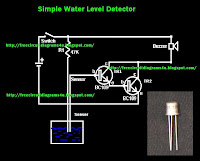
Simple Water Level Detector

This is so useful circuit diagram because this circuit helps us to detect water.When the water come and touch the sensors it will make a sound.Here I have used common transistor bc109. Actually you can modify this circuit.. By using a relay you can switch on or off your water motor I will tell you them in my next post.

Note

# Use 6V to power this circuit
# The distance between the circuit and the sensors should be short.
# Build this circuit on a pcb to get good result.
Continue Reading[...]

Sunday, May 26, 2013

12V LED Flasher for Cars

This is so wonderful circuit diagram Because you can up grade the out look of you car or van by using this simple circuit .Actually this is a blinking Led circuit on the other hand this circuit is called multivibrator circuit.The impotent thing of this circuit is this circuit can be operated with 12V power supply

Note

# By using R2, R3, C1 ,C2 you can change the speed of the circuit
# Fix this on a pcb
# Dont supply more than 12V
# This circuit can generate about 5W power
Continue Reading[...]

Sunday, May 19, 2013

Electronics Dog Repellent


The electronic dog repellent circuit diagram below is a high output ultrasonic transmitter which is primarily intended to act as a dog and cat repeller, which can be used individuals to act as a deterrent against some animals. It should NOT be relied upon as a defence against aggressive dogs but it may help distract them or encourage them to go away and do not consider this as an electronic pest repeller.

The ultrasonic dog repellant uses a standard 555 timer IC1 set up as an oscillator using a single RC network to give a 40 kHz square wave with equal mark/space ratio. This frequency is above the hearing threshold for humans but is known to be irritating frequency for dog and cats.
Since the maximum current that a 555 timer can supply is 200mA an amplifier stage was required so a high-power H-bridge network was devised, formed by 4 transistors TR1 to TR4. A second timer IC2 forms a buffer amplifier that feeds one input of the H-bridge driver, with an inverted waveform to that of IC1 output being fed to the opposite input of the H-bridge.

For more electronic dog repeller circuits check the related links bellow.
This means that conduction occurs through the complementary pairs of TR1/TR4 and TR2/TR3 on alternate marks and spaces, effectively doubling the voltage across the ultrasonic transducer, LS1. This is optimised to generate a high output at ultrasonic frequencies.

This configuration was tested by decreasing the frequency of the oscillator to an audible level and replacing the ultrasonic transducer with a loudspeaker; the results were astounding. If the dog repellent circuit was fed by a bench power supply rather than a battery that restrict the available current, the output reached 110dB with 4A running through the speaker which is plenty loud enough!

The Dog and Cat repellant was activated using a normal open switch S1 to control the current consumption, but many forms of automatic switching could be used such as pressure sensitive mats, light beams or PIR sensors. Thus it could be utilise as part of a dog or cat deterrent system to help prevent unwanted damage to gardens or flowerbeds, or a battery powered version can be carried for portable use. Consider also using a lead-acid battery if desired, and a single chip version could be built using the 556 dual timer IC to save space and improve battery life.
Continue Reading[...]

Friday, May 17, 2013

MSK5012 Adjustable Voltage Regulator 10A

MSK5012 is a awful reliable adjustable voltage regulator.Whose achievement can be programmed application two resistors. The regulator has a actual low dropout voltage(0.45v @10A )due to the acceptance of MOSFT with actual low Rds (ON) as the centralized alternation canyon element.The MS5012 has a top akin of accurateness and ripple bounce is about 45dB. It is accessible in a 5 pin Sip amalgamation that is electrically abandoned from the centralized circuitry. This accord us the abandon to fit the IC anon to the calefaction bore and this array of absolute heatsinking improves the thermal dissipation. 

The achievement voltage of this circuit is adjustable from 1.3v to 36v DC.Resistors R1 and R2 are acclimated for programming the achievement voltage. For all applications, amount of R2 is anchored to 10K. The accord amid R1,R2 and achievement voltage Vout is according to the blueprint R1=R2(Vout/1.235)-1. C1 is a clarify capacitor which is aswell a allotment of the aboideau drive circuit of the centralized alternation canyon MOSFET. About three times the ascribe voltage will arise beyond this capacitor and so the its voltage appraisement have to be called accordingly.C2 is the ascribe clarify capacitor while C3 is the achievement clarify capacitor.
Continue Reading[...]