Showing posts with label flasher. Show all posts
Showing posts with label flasher. Show all posts
Sunday, May 26, 2013
12V LED Flasher for Cars
This is so wonderful circuit diagram Because you can up grade the out look of you car or van by using this simple circuit .Actually this is a blinking Led circuit on the other hand this circuit is called multivibrator circuit.The impotent thing of this circuit is this circuit can be operated with 12V power supply
 Note
Note
# By using R2, R3, C1 ,C2 you can change the speed of the circuit
# Fix this on a pcb
# Dont supply more than 12V
# This circuit can generate about 5W power
Continue Reading[...]
Note# By using R2, R3, C1 ,C2 you can change the speed of the circuit
# Fix this on a pcb
# Dont supply more than 12V
# This circuit can generate about 5W power

Sunday, April 21, 2013
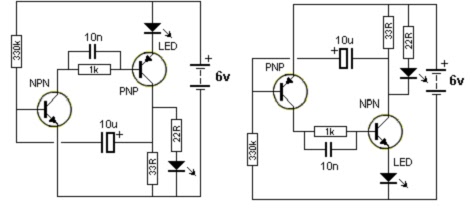
LED FLASHER
These 2 circuits can flash a LED terribly bright and consume but 2mA average current. The second circuit permits you to use a high power NPN transistor because the driver if a number of LEDs have to be compelled to be driven. The second circuit is that the basis for a straightforward motor speed management. See note on 330k in Flashing 2 LEDs below.

FLASHING 2 LEDS
These 2 circuits can flash 2 LEDs terribly bright and consume but 2mA average current. They need 6v provide. The 330k might have to be 470k to provide flashing on 6v as 330k activates the primary transistor an excessive amount of and also the 10u doesnt flip the primary transistor off alittle quantity when it becomes totally charged and so cycling isnt made.
These 2 circuits can flash 2 LEDs terribly bright and consume but 2mA average current. They need 6v provide. The 330k might have to be 470k to provide flashing on 6v as 330k activates the primary transistor an excessive amount of and also the 10u doesnt flip the primary transistor off alittle quantity when it becomes totally charged and so cycling isnt made.
Saturday, April 13, 2013
Simple Cheap LED flasher

This two LED flasher circuit uses any DC supply from 3V to 12V. Flash rate is controlled by R1,C1 and R2,C2. Larger values create slower fash rates, smaller values higher flash rates.
Subscribe to:
Comments (Atom)