Showing posts with label switch. Show all posts
Showing posts with label switch. Show all posts
Tuesday, September 10, 2013
Touch Controlled Mute Switch Circuit Diagram
Here is another simple circuit to mute the volume of Audio devices through simple touch. It exploits the action of the flip-flops in the timer IC 555 to reduce the volume of the Audio amplifier. IC NE555 is designed in the toggle mode. Its lower and upper comparator inputs are connected to the touch plates which can be membrane switches or two pieces of conducting plates. The inputs of comparators are stabilized through R1 and R2 to avoid floating.
Touch controlled Mute switch circuit diagram
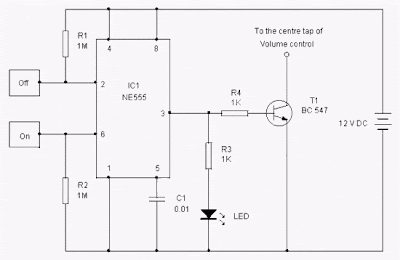
When the touch plate connected to pin 2 is touched momentarily, output of IC1 goes high and T1 conducts. The centre tap of the volume control is connected to the collector of T1. So when T1 conducts current going to the amplifier drains through T1. This reduces the volume.IC1 remains latched in this position with LED on. When the touch plate connected to pin 6 is touched momentarily, output of IC1 goes low and T1 turns off. This restores the volume.

Wednesday, April 10, 2013
Mains Remote Switch
This compact design forms a remotely operated switch that receives its control signal via the mains voltage. The switch is operated using the ‘mains remote transmitter’ described elsewhere in this issue. With this transmitter, a switch should be connected between pins 1 and 2 of K1. Depending on the application, this must be either a press contact or a make contact. The idea of the ‘mains remote switch’ is that a relay is energized in order to connect the mains voltage on K1 through to K2. The ‘receiver’ (a somewhat exaggerated term for such a simple design) is formed by Tr1 and the tuned circuit L1/C4. The network C1/Tr1/C2 serves as a coupled circuit tuned to the frequency of 143 kHz generated by the transmitter.

The selectivity is determined by L1/C4 and is primarily dependent on the standard suppression coil L1. Gain for operating the relay is provided by T1. The amplified signal is smoothed by C6 and provides the voltage necessary to cause T2 to conduct and energize the relay. The voltage divider formed by P1, R1 and R2 provides a bias voltage for T1 in order to increase the sensitivity of the receiver. This also allows the relay to be energized without a received signal. D1ensures that C5 does not become charged and prevents T1 from conducting even more.

The operation of the circuit is based on the fact that the incoming signal is sufficiently strong to overcome the hysteresis of the relay. Once the signal is no longer present, the relay must naturally again release. To be honest, it must be noted that the simple design of this circuit has the disadvantage that its sensitivity may be somewhat inadequate, depending on household circumstances. One possible solution is to reduce the frequency of the transmitter to the region between 95 and 125 kHz. The values of C1, C2 and C4 will then have to be modified to match, so this is something for readers who like to experiment.

Do not forget that just as with the transmitter, the entire circuit (once it has been switched on, of course) is connected to the mains potential. Power for the transistor stage and the relay is taken directly from the mains voltage using a capacitive voltage divider; R5 is only necessary to limit the current through the diodes to a safe value on switch-on. Rectification is provided by diodes D4–D7 and filtering by C7. The impedance of C8 is low enough to provide sufficient current. The no-load voltage (when T2 is not conducting and the relay is not activated) is limited by zener diode D3.

R6 and R7 discharge C8 immediately after the circuit is disconnected from the mains, in order to prevent any dangerous voltage from remaining on the input terminals. Connections A and B are provided for test purposes and also allow something other than the relay to be energised (but keep in mind that the circuit is electrically connected to the mains network!). The pinout of the relay is standard, so a type other than that shown in the components list can also be used, as long as you make sure that the operating voltage is 24 V and the operating current does not exceed 28mA.
Resistors:
Continue Reading[...]
The selectivity is determined by L1/C4 and is primarily dependent on the standard suppression coil L1. Gain for operating the relay is provided by T1. The amplified signal is smoothed by C6 and provides the voltage necessary to cause T2 to conduct and energize the relay. The voltage divider formed by P1, R1 and R2 provides a bias voltage for T1 in order to increase the sensitivity of the receiver. This also allows the relay to be energized without a received signal. D1ensures that C5 does not become charged and prevents T1 from conducting even more.
The operation of the circuit is based on the fact that the incoming signal is sufficiently strong to overcome the hysteresis of the relay. Once the signal is no longer present, the relay must naturally again release. To be honest, it must be noted that the simple design of this circuit has the disadvantage that its sensitivity may be somewhat inadequate, depending on household circumstances. One possible solution is to reduce the frequency of the transmitter to the region between 95 and 125 kHz. The values of C1, C2 and C4 will then have to be modified to match, so this is something for readers who like to experiment.
Do not forget that just as with the transmitter, the entire circuit (once it has been switched on, of course) is connected to the mains potential. Power for the transistor stage and the relay is taken directly from the mains voltage using a capacitive voltage divider; R5 is only necessary to limit the current through the diodes to a safe value on switch-on. Rectification is provided by diodes D4–D7 and filtering by C7. The impedance of C8 is low enough to provide sufficient current. The no-load voltage (when T2 is not conducting and the relay is not activated) is limited by zener diode D3.
R6 and R7 discharge C8 immediately after the circuit is disconnected from the mains, in order to prevent any dangerous voltage from remaining on the input terminals. Connections A and B are provided for test purposes and also allow something other than the relay to be energised (but keep in mind that the circuit is electrically connected to the mains network!). The pinout of the relay is standard, so a type other than that shown in the components list can also be used, as long as you make sure that the operating voltage is 24 V and the operating current does not exceed 28mA.
Resistors:
- R1 = 1MΩ5
- R2 = 220kΩ
- R3 = 39kΩ
- R4 = 6kΩ8
- R5 = 220Ω
- R6,R7 = 470kΩ
- P1 = 10MΩ preset
- C1 = 22nF 275VAC Class X2, lead pitch 15mm
- C2 = 22nF, lead pitch 5 mm
- C3 = 220pF
- C4 = 2nF2, lead pitch 5mm
- C5 = 680pF
- C6 = 100nF, lead pitch 5 mm
- C7 = 100µF 40V radial
- C8 = 330nF 275VAC, Class X2, lead pitch 22.5mm or 27.5mm
- L1 = 470µH
- D1 = BAT85
- D2 = 1N4148
- D3 = zener diode 24V 1.3W
- D4-D7 = 1N4007
- T1 = BC557B
- T2 = BC547B
- K1,K2 = 2-way PCB header, lead pitch 7.5 mm
- Tr1 = 5:5 turns 1mm dia. isolated wire on N30 ring core 16x6.3 mm, B64290L45X830 EPCOS
- Re1 = PCB relay, 1 c/o contact, 8A 24V 1200Ω,
Saturday, March 30, 2013
Pushbutton Switch
This circuit acts like a two-position switch but is operated using a pushbutton. After power has been applied, the circuit is in the following initial state: the bases of T1 and T2 are at the positive supply potential and the base of T3 is at ground potential. All transistors are cut off. The other contact of the pushbutton is at ground potential. No current flows through the relay coil and the status LED is off.
Pushbutton Switch Circuit diagram :

If the pushbutton is pressed, T2 and (after a slight delay due the RC network) T3 switch on. The collector of T3 is now nearly at ground potential, so current flows through the relay coil and the function LED is illuminated. T1 can also switch on. This situation is stable, since ground potential can reach the base of T2 via R1, so nothing changes when the pushbutton is released. C1 is charged via R3 to cause a positive potential to be present at the pushbutton. If the pushbutton is now pressed again, it connects a positive potential to the base of T2 instead of the ground potential. This causes everything to toggle back into the initial state.
Similar operation can be obtained using a thyristor circuit, and in fact T2 and T3 form a sort of thyristor. However, the circuit shown here is largely independent of the voltage and current demands of the connected load. The relay coil should be suit-able for the supply voltage (5–12 V) and should not draw more than 250 mA, since otherwise T3 will go up in smoke. With our lab prototype, we measured a current consumption of 70 mA in the ‘on’ state and less than 0.1 mA in the ‘off’ state.
Source : www.ecircuitslab.com
Subscribe to:
Comments (Atom)