Showing posts with label with. Show all posts
Showing posts with label with. Show all posts
Wednesday, June 12, 2013
10Watt Audio Amplifier with Bass boost circuit

Circuit diagram
parts list
P1_________________22K Log.Potentiometer (Dual-gang for stereo)
P2________________100K Log.Potentiometer (Dual-gang for stereo)
R1________________820R 1/4W Resistor
R2,R4,R8____________4K7 1/4W Resistors
R3________________500R 1/2W Trimmer Cermet
R5_________________82K 1/4W Resistor
R6,R7______________47K 1/4W Resistors
R9_________________10R 1/2W Resistor
R10__________________R22 4W Resistor (wirewound)
C1,C8_____________470nF 63V Polyester Capacitor
C2,C5_____________100µF 25V Electrolytic Capacitors
C3,C4_____________470µF 25V Electrolytic Capacitors
C6_________________47pF 63V Ceramic or Polystyrene Capacitor
C7_________________10nF 63V Polyester Capacitor
C9________________100nF 63V Polyester Capacitor
D1______________1N4148 75V 150mA Diode
IC1_____________NE5532 Low noise Dual Op-amp
Q1_______________BC547B 45V 100mA NPN Transistor
Q2_______________BC557B 45V 100mA PNP Transistor
Q3_______________TIP42A 60V 6A PNP Transistor
Q4_______________TIP41A 60V 6A NPN Transistor
J1__________________RCA audio input socket
Power supply circuit

Circuit diagram
Parts R11_________________1K5 1/4W Resistor
C10,C11__________4700µF 25V Electrolytic Capacitors
D2________________100V 4A Diode bridge
D3________________5mm. Red LED
T1________________220V Primary, 12 + 12V Secondary 24-30VA Mains transformer
PL1_______________Male Mains plug
SW1_______________SPST Mains switch .Electronics Circuit Application

Tuesday, April 30, 2013
Modded PC Inspired With Frank Lloyd Wright
You think you already see all the possible case mods? This mod was inspired by the work of the famous Fallingwater architect Frank Lloyd Wright.
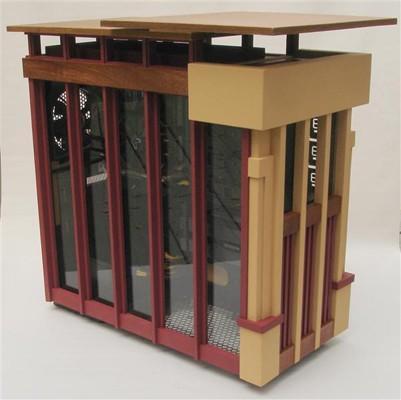
The inspired drink bar cantilevered roofs from teak, mahogany highlights, the Cherokee red and covered wagon code colors it is enough to architecture nerd powerlessness. Its fine styling sports has an Intel Core i7-875 GB on Mini-ITX motherboard, with 8 GB of system memory. It has a 256 GB SSD with a 2 TB hard drive.
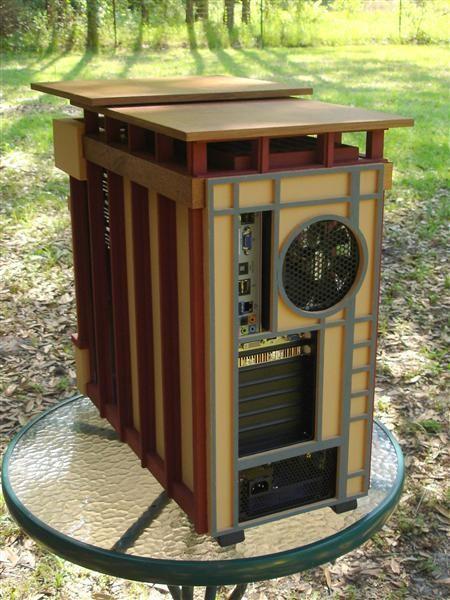
This desktop cases don’t really tend to get hot, just the components and definitely wouldnt be worried about a fire-hazard. The top looks like it has pretty good airflow too.
Thursday, April 11, 2013
Digital Dice With 7 Segment Display
A digital dice circuit can be easily realised using an astable oscillator circuit followed by a counter, display driver and a display. Here we have used a timer NE555 as an astable oscillator with a frequency of about 100 Hz. Decade counter IC CD4026 or CD4033 (which-ever available) can be used as counter-cum-display driver. When using CD4026, pin 14 (cascading output) is to be left unused (open), but in case of CD4033, pin 14 serves as lamp test pin and the same is to be grounded.
Circuit diagram :
Digital Dice With 7-Segment Display Circuit diagram
The circuit uses only a handful of components. Its power consumption is also quite low because of use of CMOS ICs, and hence it is well suited for battery operation. In this circuit two tactile switches S1 and S2 have been pro-vided. While switch S2 is used for initial resetting of the display to ‘0,’ depression of S1 simulates throwing of the dice by a player.
When battery is connected to the circuit, the counter and display section around IC2 (CD4026/4033) is energised and the display would normally show ‘0’, as no clock input is available. Should the display show any other decimal digit, you may press re-set switch S2 so that display shows ‘0’. To simulate throwing of dice, the player has to press switch S1, briefly. This ex-tends the supply to the astable oscillator configured around IC1 as well as capacitor C1 (through resistor R1), which charges to the battery voltage. Thus even after switch S1 is released, the astable circuit around IC1 keeps producing the clock until capacitor C1 discharges sufficiently. Thus for du-ration of depression of switch S1 and discharge of capacitor C1 thereafter, clock pulses are produced by IC1 and applied to clock pin 1 of counter IC2, whose count advances at a frequency of 100 Hz until C1 discharges sufficiently to deactivate IC1.
When the oscillations from IC1 stop, the last (random) count in counter IC2 can be viewed on the 7-segment display. This count would normally lie between 0 and 6, since at the leading edge of every 7th clock pulse, the counter is reset to zero. This is achieved as follows.

Observe the behavior of ‘b’ segment output in the Table. On reset, at count 0 until count 4, the segment ‘b’ output is high. At count 5 it changes to low level and remains so during count 6. However, at start of count 7, the output goes from low to high state. A differentiated sharp high pulse through C-R combination of C4-R5 is applied to reset pin 15 of IC2 to reset the output to ‘0’ for a fraction of a pulse period (which is not visible on the 7-segment display). Thus, if the clock stops at seventh count, the display will read zero. There is a probability of one chance in seven that display would show ‘0.’ In such a situation, the concerned player is given an-other chance until the display is non-zero.
Note. Although it is quite feasible to inhibit display of ‘0’ and advance the counter by ‘1,’ the same makes the circuit somewhat complex and there-fore such a modification has not been attempted.
Source by : Streampowers
Monday, April 8, 2013
12 Volt Charger Circuit with LM350
The strength supply routine structure is developed as a resource of continuous present with adverse heat range coefficient. Transistor Q1 (BD 140) is used as a heat range indicator. transistor Q2 is used to avoid the strength supply from discharging through R1 when strength is out of stock. Getting routine is developed depending on the LM350 present regulator IC. The result present of the battery charger can be altered between 13-15 V by various the POT R6.

LM350 will try to keep the present decrease between the feedback pin and result pin at a continuous value of 1.25V. So there will be a continuous present circulation through resistor R1. Q1 act here as a heat range indicator with the help of R6/R3/R4 elements that are more or less manages the platform present of Q1. As relationship emitter / platform of transistor Q1, the same as other semiconductors, containing the heat range coefficient of-2mV / ° C, the present result will also display a bad heat range coefficient. This one is just a aspect of 4 huge, because the difference of the emitter / platform of Q1 is increased by a aspect of category P1/R3/R4. This causes some-8mV / ° C. LED will lighting whenever strength is available.
Tuesday, April 2, 2013
DC motor 12V speed controller circuit with explanation

As you can see the circuit requires few external components , but because of the encoder wheel it has a limitations of use .If you put a pulley under the encoder wheel you can command the speed of other device , by connecting the (motor and other device ) using a belt
Automobile Head Light Dipper with Cell Phone Charger Circuit
The following circuit was designed by me in response to the request sent by Miss. Surya. Actually the presented idea is a combination of three circuit designs already posted in this blog with different titles, they have been integrated together to fulfill the requested design. To see the request sent by Miss Surya you may refer here.
The following brief explanation was provided by Miss Surya for getting a better view of the proposed circuit design of an automobile automatic dimmer cum dipper head light switch circuit with an optional cell phone charger circuit for facilitating the charging of a cell phone also on board.
Circuit Description
Here the IC 555 has been used not as a charging indicator rather as a comparator for controlling the dipping action of the head lamps.
The use if IC 555 as a charging indicator would have made the circuit unnecessarily complicated, therefore a novel and simpler way is selected for the charging ON indication.
The LED connected across the 5 Ohm watt current limiting resistor effectively indicates the charging status of the cell phone and switches OFF the moment the charging process stops.
The IC 555 works like a comprartor here, when light falls on the LDR, voltage at PIN#2 rises above the set internal threshold which prompts the IC to change its output PIN#3 voltage from 0 to 12, triggering the connected relay.
The relay contacts immediately transfer the positive supply from the "high" filament to the "low" filament of the head lamps, resulting in an instant dipping of the lamp intensity.
The LDR must be positioned in such a way that it only receives light rays coming from front of the vehicle, which will be mostly the lights from another vehicles head lamps.

The following brief explanation was provided by Miss Surya for getting a better view of the proposed circuit design of an automobile automatic dimmer cum dipper head light switch circuit with an optional cell phone charger circuit for facilitating the charging of a cell phone also on board.
Circuit Description
Here the IC 555 has been used not as a charging indicator rather as a comparator for controlling the dipping action of the head lamps.
The use if IC 555 as a charging indicator would have made the circuit unnecessarily complicated, therefore a novel and simpler way is selected for the charging ON indication.
The LED connected across the 5 Ohm watt current limiting resistor effectively indicates the charging status of the cell phone and switches OFF the moment the charging process stops.
The IC 555 works like a comprartor here, when light falls on the LDR, voltage at PIN#2 rises above the set internal threshold which prompts the IC to change its output PIN#3 voltage from 0 to 12, triggering the connected relay.
The relay contacts immediately transfer the positive supply from the "high" filament to the "low" filament of the head lamps, resulting in an instant dipping of the lamp intensity.
The LDR must be positioned in such a way that it only receives light rays coming from front of the vehicle, which will be mostly the lights from another vehicles head lamps.
Subscribe to:
Comments (Atom)